
Why an Engine Stand Fights You Until the Crankshaft Lines Up With the Rotation Axis
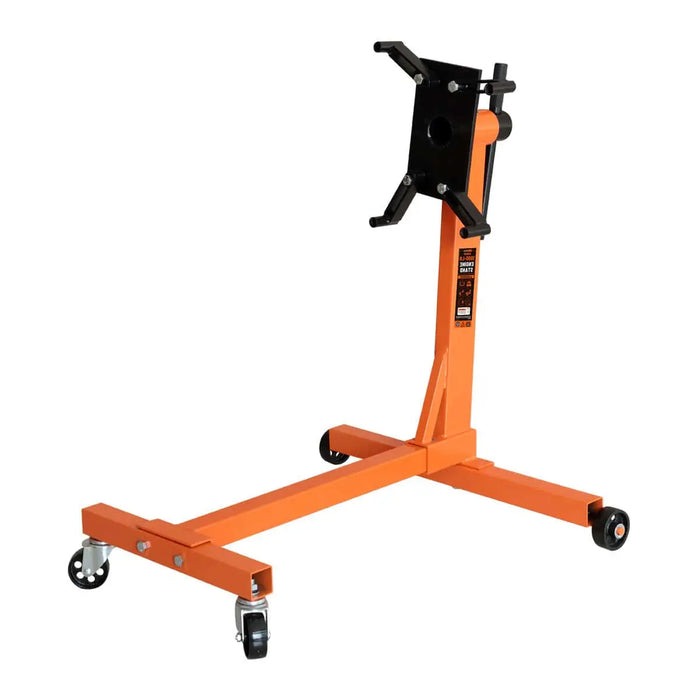
An engine on a stand is a lever before it is a weight
Winter is when a lot of Canadian garages finally get around to the long jobs, and a bare block bolted to a 1000 lb rotating engine stand is a common sight by the time the snow settles. The stand looks like a simple thing: four legs, a post, a head that turns. What catches people out is that it is not really holding a weight at all. It is holding a lever, and the length of that lever changes every time something comes off the engine.
Anyone who has spun a block over and had it suddenly run away from them has met the problem directly. Understanding where it comes from makes the difference between a controlled rotation and a four hundred pound mass deciding its own orientation.
The rating describes a hanging load, not a turning one
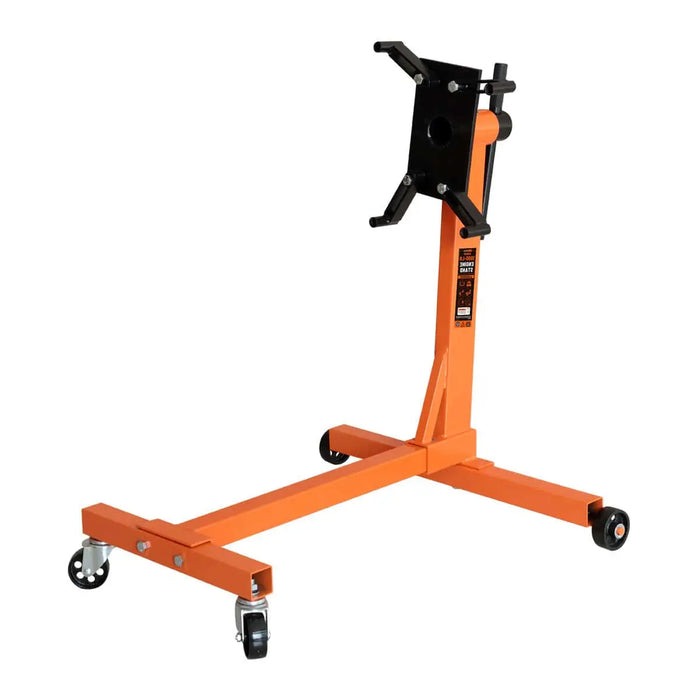
Capacity on an engine stand is quoted as a straight weight, and that figure assumes the load is reasonably compact and reasonably centered. It describes what the frame and the post will carry without deflecting.
What it cannot describe is the turning effort. That depends on how far the center of mass sits from the axis the head rotates about, and nothing on the stand knows or controls that distance. Two engines of identical weight can be trivial and alarming to rotate respectively, purely because of how they hang.
This is why experienced builders treat the rating as a floor rather than a target. Running a 400 pound engine on a stand rated for 1000 pounds is not overkill; it is leaving margin for the fact that the real loads are dynamic.
Where the rotation axis sits relative to the crankshaft
The ideal is simple to state and awkward to achieve. If the engine's center of mass sits exactly on the rotation axis, it balances in any position and turns with one hand. Every inch the mass sits away from that axis turns into a turning moment the moment you let go.
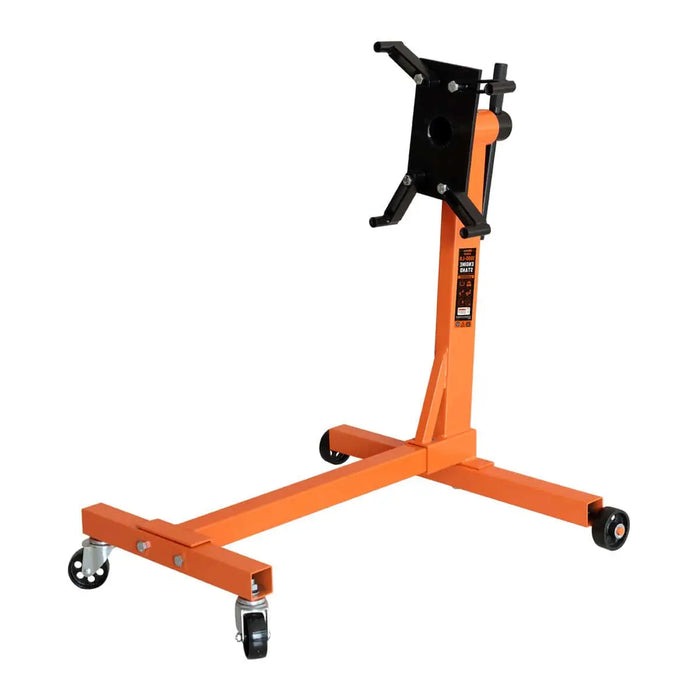
Most engines are bolted to the stand by the bellhousing face, which puts the rotation axis roughly along the crankshaft. That is a reasonable approximation, because a bare block is fairly symmetric about the crank. It stops being a good approximation as soon as anything substantial is bolted to one side.
A cylinder head on one bank, an intake manifold, or a flywheel left attached all shift the mass away from the axis. On a V configuration, where both heads sit at an angle, the imbalance is usually front to back rather than side to side, which is why a V8 often tries to rotate nose down.
Why stripping the engine changes the handling
A build is a sequence of parts coming off and going on, and each step moves the balance. This is the part nobody warns you about, because the stand feels perfectly stable right up until it does not.
Removing a head from one bank takes forty or fifty pounds off one side in a single operation. The engine that balanced a moment ago now has a strong preference about which way up it wants to be, and if the rotation lock happens to be disengaged at that moment, it will act on that preference immediately.
The habit that prevents this is simply ordering the work so the lock is engaged before anything heavy is unbolted, and treating any change in mass as a reason to re-check balance before releasing the handle.
Four arms exist because engines are not round
The mounting arms on a rotating engine stand adjust for two separate reasons, and only one of them is obvious. The first is bolt pattern: bellhousing faces vary enormously between manufacturers, and adjustable arms let one stand serve a shop that sees different engines.
The second is less discussed. Sliding the arms changes where the engine sits relative to the rotation axis, which means the arms are also the balance adjustment. Mounting an engine deliberately so the heavier end sits closer to the axis makes the whole job easier, and costs nothing but a few minutes at setup.
Using all four arms matters more than it looks. Three bolts will hold an engine, but four spread the load across the mounting face and stop the block from flexing the plate when the mass swings through the horizontal.
Casters, floors and a load that is taller than it is wide
A loaded stand is a tall, narrow, heavy object on small wheels, which is a description of something that wants to tip. Garage floors are rarely flat: most slabs are poured with a slope toward a drain or a door, and a two degree slope is invisible to the eye and obvious to a caster.
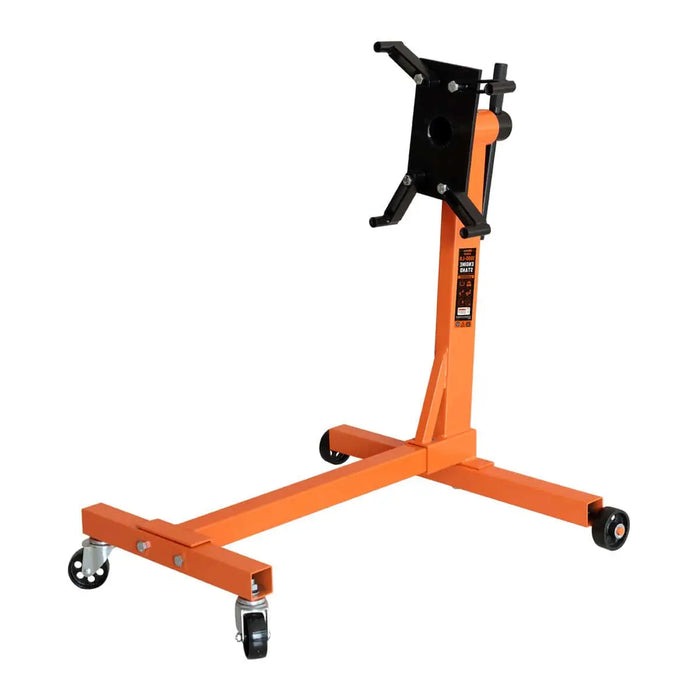
The fixed and swivel caster combination exists to manage that. Fixed casters give the frame a direction to track in, and the swivels allow steering, which is the opposite arrangement to a shopping cart and much harder to push sideways by accident.
Moving a loaded stand is the moment of highest risk. Push rather than pull, keep the engine low on the post if the design allows it, and avoid crossing cords, hoses and the lip of a drain channel with the engine rotated out of balance.
Before the engine comes off the hoist
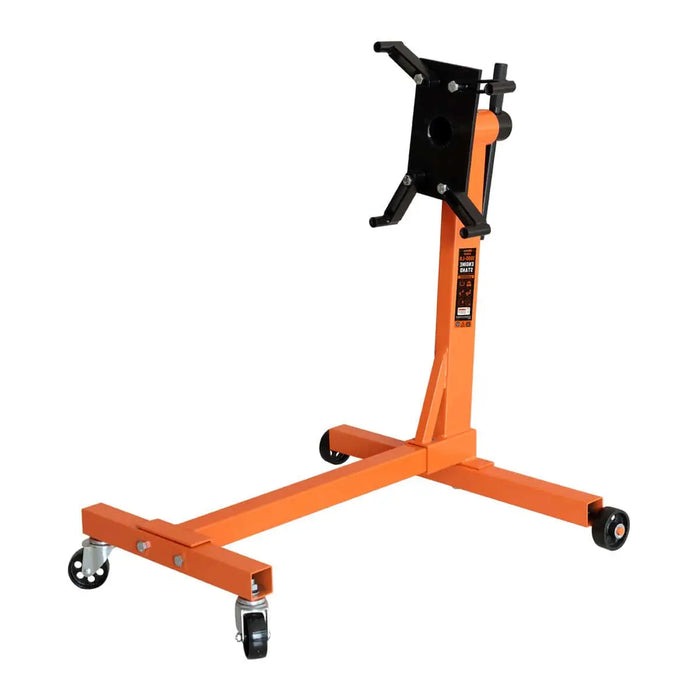
A short sequence covers the handover from an engine hoist to the stand:
Check the rating against engine plus accessories
Fit all four arms, bolts torqued
Engage the rotation lock before releasing the hoist
Test rotate a quarter turn with hands clear
That test rotation is the useful one. A quarter turn tells you where the heavy side is while you still have the hoist attached and can adjust, rather than discovering it later with nothing holding the load.
Choosing a stand for the work rather than the number
Capacity is the easy thing to compare and the least informative. More useful is whether the arms adjust far enough for the engines you actually work on, whether the rotation lock is positive rather than friction based, and whether the base is wide enough to stay stable on a sloped floor.
TMG Industrial builds this one with four adjustable arms, full rotation and a mix of fixed and swivel casters, which is the configuration that suits a shop handling different engines rather than one. Whatever stand you end up with, the question that keeps a build uneventful is not how much it can hold but where the mass is sitting when you let go of the handle.